Workshop 2026 and Member's Meeting
Dear Colleagues,
Thank you very much for the numerous registrations for the workshop as part of the 10th anniversary of the DAbG. We are pleased to announce that all submitted abstracts have been accepted for presentation as talks (12 minutes + 3 minutes for questions). For a preliminary program (subject to changes), including abstracts, see link below. Please note: For the 10th anniversary, we are planning a larger program including an ice-breaker on Sunday evening, awarding of the Ralf Möller Memorial Prize, conference dinner, as well as city and Telegraphenberg tours. As a result, this year also features a full-day scientific program extending into the evening on Tuesday (October 13th), and we kindly ask everyone to plan their schedules accordingly.
Further Information:
For any questions, please feel free to reply to this email.
Looking forward to see you all in Potsdam.
Best regards,
Jacob Heinz
(on behalf of the DAbG Board)
Research Associate for the Project “Relevance of biocrusts for carbon pools and dynamics in dryland soils in Southern Africa”
The Cluster of Excellence “Climate, Climatic Change, and Society” (CLICCS) investigates climate dynamics and climate-related social dynamics, as well as the interactions between the two. To this end, we are looking for colleagues from a wide range of disciplines, including the natural sciences as well as the social sciences. We are proud to work together in a truly integrating manner. Our partners, e.g. the Max Planck Institute for Meteorology, Helmholtz Centre Hereon or the German Climate Computing Centre are also hiring. All jobs: www.cliccs.uni-hamburg.de/jobs
Michel Mayor Fellowship
The Life in the Universe Center (Centre pour la Vie dans l'Univers) at the University of Geneva is pleased to announce the opening of the 2026 Michel Mayor Fellowship call. The Michel Mayor Fellowships support outstanding early-career researchers wishing to pursue innovative, interdisciplinary research on the origins, evolution, and detection of life in the Universe. Fellows develop an independent research project co-supervised by mentors from two different disciplines, with access to Geneva's interdisciplinary research environment. Key information: Duration: up to 3 years Eligibility: PhD obtained within approximately the last 2 years Research area: interdisciplinary projects related to Life in the Universe Application deadline: 30 October 2026, 17:00 (Swiss time) Start date: no later than July 2027 More information, eligibility criteria, available host laboratories, and application instructions can be found here: Michel Mayor Fellowships - Centre pour la Vie dans l'Univers - UNIGE ! For any questions, please contact: cvu_admin_at_unige.ch.
Workshop "Introduction to Planetary Protection"
ESA, October 06.-08. 2026. For details see Introduction to Planetary Protection - Fraunhofer IPA
Workshop 2026 and Member's Meeting
Dear DAbG members,
This year marks the tenth anniversary of the founding of our society. For this reason, our workshop combined with the members' meeting this year is also intended to be a special event with numerous activities, including an icebreaker on Sunday.
We plan to hold our meeting on the days from
October 11 to 13, 2026
at the Telegrafenberg in Potsdam at the GFZ Helmholtz Centre for Geosciences.
In order for us to properly estimate the number of participants for further planning, we would be grateful for a prompt short response indicating your interest. The number of participants is limited this time, so early pre-registration is important. Please use the link to the Nuudle survey (GDPR-compliant, without insight into the voting results of other participants) to indicate your interest:
https://nuudel.digitalcourage.de/nRH5ublIs8SfMhAo
Further information such as deadlines, links, and registration formalities will be provided in due course.
As usual, a limited number of travel grants can be awarded to students and early-career researchers for participation in the workshop: https://www.astrobiologie.de/aktivitaeten/reisekostenzuschuesse/
Please send your application to our treasurer Dirk Wagner (dirk.wagner_at_gfz.de). We would be pleased to welcome you to the workshop and the general meeting!
With best regards
Christian Mayer
(on behalf of the board)
15 MSCA Doctoral Positions (PhD) in Planetary Exploration – EXODOCS Doctoral Network
Are you passionate about planetary exploration? Do you want to contribute to a flagship ESA Astrobiology mission? Would you like to join the ExoMars Rosalind Franklin Mission science team in the search for life on Mars?
This is a unique opportunity to launch your career in planetary science and space research.
We are excited to announce that the 15 PhD positions of the EXODOCS Doctoral Network are published on EURAXESS:
These positions are distributed across leading European institutions in planetary science and space research, offering cutting-edge training and direct involvement in ExoMars-related science and operations.
Application deadline: 31 May 2026
Planetary Protection for Sustainable Space Exploration
Royal Society Publishing has recently published an OPEN ACCESS theme issue of
Philosophical Transactions A: Planetary Protection for sustainable space exploration
compiled and edited by Karen Olsson-Francis, Athena Coustenis, Peter Doran,
Petra Rettberg, Niklas Hedman and Jean-Claude Worms and the articles are FREE to access at www.bit.ly/TransA2314
COSPAR 2026
COSPAR 2026 will bring together approximately 3000 scientists and engineers from the all over the world to present the latest results in symposia covering all areas of space science from space life sciences to space exploration and offering also interesting opportunities for students and young scientists to get a general overview about space research and to start networking.
Abstract deadline: 13 February 2026
Early registration deadline: 17 May 2026
For details, see https://cospar2026.org/
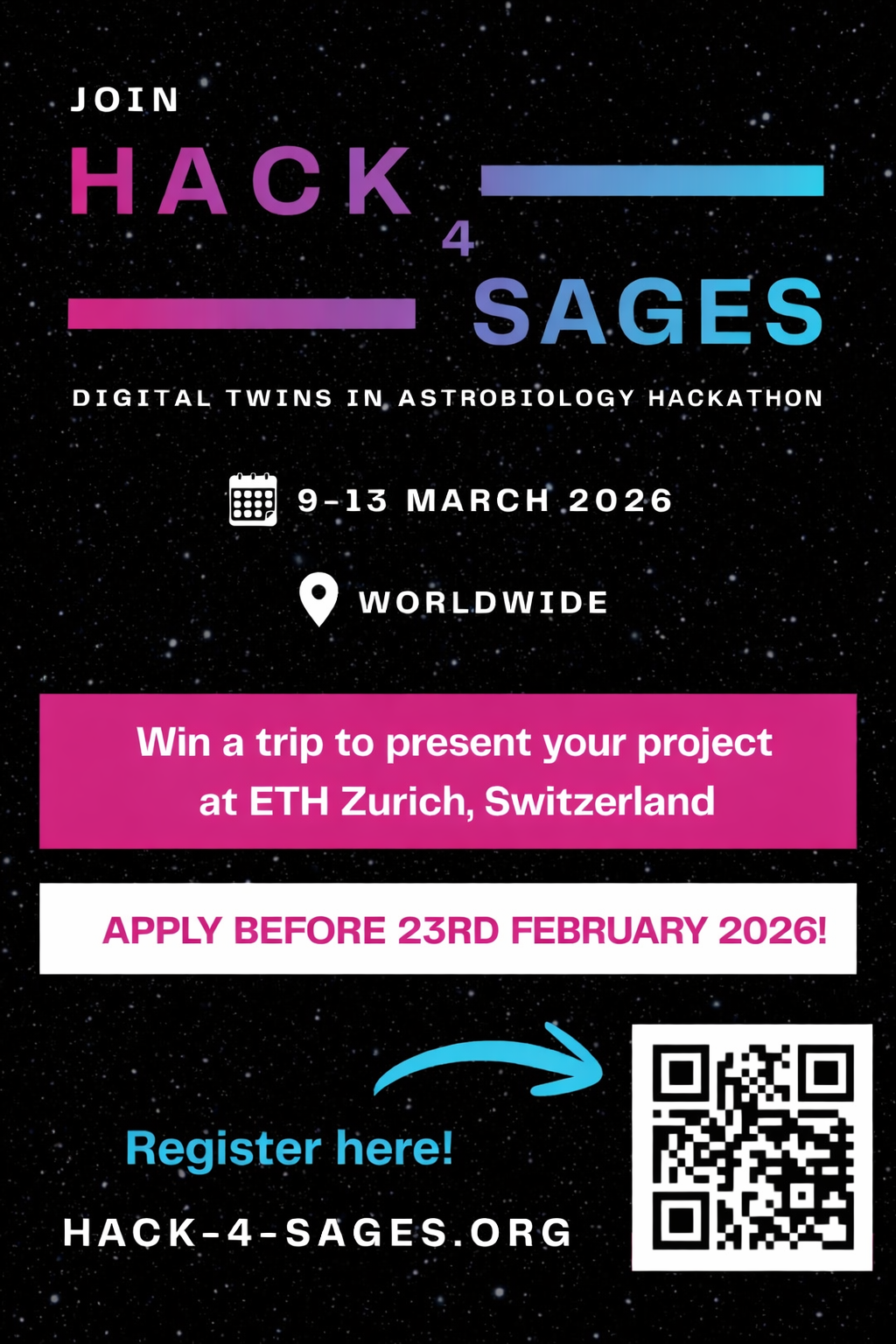
🚀 What is HACK-4-SAGES?
A 4-day hybrid hackathon for bachelors and undergraduate students worldwide. The theme is digital twins in astrobiology.
🕰️ When does it take place?
The main hackathon takes place from 10 to 12 March 2026.
A welcome webinar is held on 9 March, and the winners are announced live on 13 March.
💻 Where does it take place?
It takes place online and at our hosting and co-hosting institutions. The full list of in-person locations is available on our website. Students are welcome to participate online.
💫 Important dates
• 23 February: registration deadline
‼️ Mentor call
Each team needs a mentor, so we are also inviting scientific staff members (PhD student level or above) to apply. The mentor form is here.
Possible Protocell-formation
on Saturn's moon Titan
Based on the present knowledge of the atmosphere of Saturn’s moon Titan, Christian Mayer (DAbG) and Conor Nixon (NASA) propose a mechanism for the formation of cell-like vesicles. Similar to biological cells, these vesicles exhibit a double-layer membrane and are capable of undergoing a Darwinian evolution process. Appropriate detection methods are planned for future research missions to Titan.
The mechanism has been visualized by NASA Goddard Space Flight Center
(Video: vesicle formation on Titan)
Original Paper: Mayer/Nixon: International Journal of Astrobiology
Professur
im Fachbereich Chemie und Biochemie
mit Schwerpunkt auf Präbiotischer Chemie
im
Life in the Universe Center
der Universität Genf
Die Deadline für eine Bewerbung ist der 15. März 2026, voraussichtliches Antrittsdatum der Stelle ist im September 2026.
Mehr Informationen unter https://www.unige.ch/sciences/cvu/
We may be looking for Martian life in the wrong place
https://www.nature.com/articles/s41550-024-02381-x
https://bigthink.com/hard-science/follow-the-salt-a-new-strategy-for-finding-life-on-mars
Payload Proposals for SpinSat Platform
Dear colleagues of Commission F,
I am part of a NASA Ames-led team that is developing the SpinSat platform, a multi-payload spinning satellite that will provide centrifugal gravity in beyond-LEO radiation environments.
We recently released a request for information (RFI) via SAM.gov, aimed to solicit interest and responses from those who might propose science payloads for this platform, as well as those who could develop payload hardware to enable such experiments to fly on SpinSat.
Please see the SpinSat RFI for descriptive details and to be added to the e-mailing list for updates, and please contact julie.k.fletcher_at_nasa.gov (or me) if you have questions. We would welcome a response from you to this RFI!
Sincerely,
Dr. Petra Rettberg
=================================================

